
No products in the cart.
Blog
Ordering Custom Woven Clothing Labels? Avoid These 3 Mistakes

11
Mar
Mar
Designing custom woven clothing labels is an exciting step for any clothing brand. Many designers spend hours refining their logo, selecting colors, and imagining how their finished garments will look once their brand label is sewn in.
Woven labels are widely considered the gold standard for garment branding because they are durable, professional looking, and help reinforce brand identity. However, ordering custom woven clothing labels involves a few important steps that are easy to overlook, especially for new designers.
Below are three of the most common mistakes clothing designers make when ordering custom woven clothing labels — and how to avoid costly production problems.
1. Not Carefully Reviewing the Label Proof and Sew-Out Sample
Before woven labels go into full production, a label supplier should provide an art proof showing the layout of your label design. This digital proof acts as a blueprint for the weaving process and typically includes:
Exact label size
Thread colors
Logo placement
Border style
Folding method
Reviewing the art proof carefully is critical. This is the final opportunity to verify that everything looks correct before the label is woven.
The image below shows a side-by-side comparison of a woven label art proof and the final woven label after production.
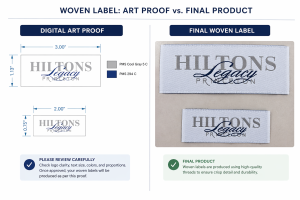
If possible, you may also request sample labels from previous production runs. Seeing and feeling actual woven labels can help you better understand fabric types, thread detail, and overall label quality.
Once the artwork is approved, the weaver may provide a sew-out sample, which is an actual woven label produced according to your specifications. A photo of this sample is usually sent for final approval before the full order begins.
This step should never be rushed. Always double-check:
logo clarity
text size
color accuracy
label dimensions
Once production starts, making changes becomes much more difficult.
2. Not Allowing Enough Sewing Space on the Label
Another common mistake when ordering custom woven clothing labels is forgetting to allow enough space for sewing.
Many designers focus only on the visible part of the label design but forget that the label also needs room for stitching into the garment. This is called seam allowance.
Different sewing methods require different amounts of space.
For example:
Labels sewn into seams
If the label will be inserted into a seam, most manufacturers recommend leaving about 0.25 inches of extra material for stitching.
Labels sewn on all four sides
If the label will be stitched flat onto the garment, a sewing allowance of around 0.125 inches on each side is typically sufficient.
Top-stitched labels or cuff labels
If the label is only stitched across the top edge, a smaller sewing margin may be used.
It is also important to leave a small amount of space between the edge of your logo and the stitching area. This ensures the design appears centered and clean once the label is sewn into the garment.
A knowledgeable label supplier can help you determine the correct label size and folding style based on how the label will be applied.
The example below shows woven clothing labels that were designed with very little sewing allowance at top.
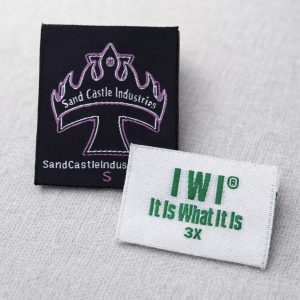
3. Waiting Too Long to Order Your Woven Labels
Timing is another issue that can cause problems during garment production.
Even experienced clothing designers sometimes underestimate how long it takes to manufacture custom woven labels.
Typical production timelines for woven labels are around two weeks, depending on order quantity and complexity. Rush production may be available, but it often involves additional costs.
Waiting until the last minute can create several problems:
Rush production fees
Expedited shipping costs
Limited time to review samples
Increased stress during production
Planning ahead allows time for proof approval, sample review, and any necessary design adjustments. Clothing brands must also comply with FTC textile labeling rules regarding fiber content, country of origin, and manufacturer identification.
Ordering labels early helps ensure your branding materials arrive before your garments are ready for production.
Choosing the Right Woven Label for Your Brand
Woven labels come in several material types, each with its own characteristics. Common options include:
Damask woven labels – the most detailed and popular option
Satin woven labels – smooth and shiny appearance
Taffeta woven labels – durable and slightly stiffer
The right choice depends on your garment type, logo complexity, and desired brand aesthetic. See the below video to help you decide.
If you are unsure which type of woven label will work best for your design, speaking with an experienced label provider can help you select the best option.
Need Help Designing Your Woven Clothing Labels?
Designing woven labels involves more than simply uploading a logo. Details such as label size, folding style, thread colors, and sewing space all play a role in how your final garment label will look.
If you have questions about your design or need help selecting the right woven label for your clothing line, call us or email us and our team will be happy to help guide you through the process.