
No products in the cart.
Blog
RFID Tag Cost: Why Printing RFID Tags Costs More Than Standard Labels

13
Mar
Mar
RFID technology has become an important tool for retailers and suppliers looking to improve inventory tracking and supply chain visibility. By allowing products to be scanned wirelessly, RFID tags make it possible to track inventory in real time and manage large product volumes with far greater accuracy.
However, many companies are surprised when they first learn how RFID tag cost compares to traditional barcode labels or hangtags. While RFID technology offers significant operational benefits, the production of RFID tags involves additional materials, manufacturing processes, and encoding steps that increase the overall cost.
Understanding what drives the cost of RFID tags can help apparel brands and retail suppliers make better decisions when implementing RFID labeling programs.
How Much Do RFID Tags Cost?
RFID tag cost varies depending on volume, materials, and encoding requirements. In general, standard RFID tags can range from a few cents per unit for high-volume orders to higher costs for specialized applications. Factors such as chip type, antenna design, and printing complexity all influence the final price.
Several factors influence RFID tag cost, including:
• Type of RFID chip used (your trading partner will provide you with most of this information)
• Antenna material and design
• Tag size and construction
• Encoding and serialization requirements
• Order volume
Why RFID Tag Cost Is Higher Than Standard Labels
Unlike traditional printed labels, RFID tags contain electronic components that allow them to communicate with RFID readers.
A standard printed barcode label simply displays visual information that must be scanned with a line-of-sight barcode scanner. RFID tags, however, contain a microchip and antenna that transmit data using radio signals.
Because of this added technology, RFID tags require more complex manufacturing and quality control processes than standard labels or hangtags.

RFID Tags Require Specialized Materials
One of the biggest contributors to RFID tag cost is the antenna used to transmit radio signals.
Most RFID antennas are made from etched aluminum, copper, or conductive inks that must be precisely manufactured in order to communicate effectively with RFID readers. These antennas are then bonded to a microchip that stores the product’s unique identifier.
This combination of electronic components adds material costs that do not exist with traditional printed labels. The materials used in RFID inlays and antennas are one of the primary reasons RFID tag cost is higher than standard printed labels. RFID chip costs can vary significantly depending on memory capacity, frequency requirements, and the type of retail application being supported.
Multi-Layer RFID Tag Construction
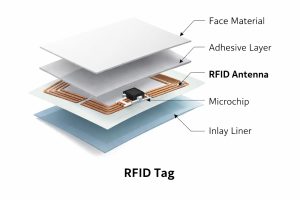
RFID tags are also constructed using multiple layers.
In addition to the printed face material, RFID tags contain an inlay that holds the antenna and microchip. This inlay must be carefully laminated between layers to protect the electronic components while still allowing the signal to transmit correctly.
This layered construction process adds additional manufacturing steps and increases the complexity of RFID tag production and RFID basics.
RFID Encoding and Data Management
Another factor that increases the cost of RFID labels is the encoding process.
Each RFID tag must be programmed with a unique electronic product code (EPC). This allows individual items to be tracked through warehouses, distribution centers, and retail stores.
Encoding RFID tags requires specialized printers, software, and verification equipment to ensure that each chip is programmed correctly. This additional step adds both equipment costs and labor costs compared to traditional label printing.
Retail Compliance and RFID Programs
Many suppliers are implementing RFID labeling because large retailers now require it.
Programs such as the Walmart RFID mandate require suppliers in certain product categories to apply RFID tags to apparel and other merchandise. These tags allow retailers to improve inventory accuracy, reduce shrinkage, and manage stock levels more efficiently. Read more about GS1 RFID overview.
For suppliers working with major retailers, RFID labeling has become an important part of retail compliance and supply chain management.
Long-Term Value of RFID Technology
While RFID tags cost more than traditional labels, many companies find that the long-term benefits outweigh the initial investment.
RFID technology helps businesses:
• Improve inventory accuracy
• Reduce manual inventory counting
• Detect missing products faster
• Improve supply chain visibility
• Reduce retail shrinkage
For companies managing large product volumes, these advantages can lead to significant operational savings and improved inventory control.
Need RFID Labels or RFID Hangtags?
Rapidtags works with apparel brands and suppliers to produce RFID labels and RFID hangtags designed for retail compliance programs.
Our team helps companies implement RFID tagging solutions that meet retailer requirements while supporting modern inventory management systems.
If you have questions about RFID labeling, feel free to call 877-438-8247 or email us at sales@rapidtags.com
Related RFID Articles
• Walmart RFID Requirements for Apparel Suppliers
• Why RFID Tags Cost More Than Standard Labels and Hangtags
• How RFID Helps Reduce Retail Shrinkage
Walmart RFID Requirements: What Apparel Suppliers Need to Know