
No products in the cart.
Blog
Walmart RFID Requirements: What Apparel Suppliers Need to Know

26
Feb
Feb
The Walmart RFID mandate requires many apparel suppliers to apply RFID tags to products in order to improve inventory accuracy, reduce shrinkage, and meet retail compliance requirements. This requirement was introduced to improve inventory accuracy, reduce shrinkage, and ensure that products are available for customers both in stores and online. This program is commonly referred to as the Walmart RFID mandate, which requires many suppliers to apply RFID tags to products before they enter Walmart’s distribution network.
RFID stands for Radio Frequency Identification, a technology that allows retailers to track products using small electronic tags embedded in labels or hangtags. Unlike traditional barcodes, RFID tags can be scanned wirelessly using radio waves, making it possible to read many items simultaneously without direct line-of-sight scanning. Walmart suppliers often use RFID labels and RFID hangtags to comply with inventory tracking requirements across distribution centers and retail stores.
For large retailers like Walmart, this technology dramatically improves inventory management and supply chain efficiency.
How the Walmart RFID Mandate Uses RFID Technology
An RFID system typically consists of three primary components:
• Antenna – sends and receives radio signals
• Transceiver (reader) – interprets the signals received
• Transponder (RFID tag) – the small chip and antenna attached to a product

When an RFID reader sends out a radio signal, nearby RFID tags respond with encoded data. This information is transmitted back to the reader and processed by inventory systems.
Most Walmart-compliant RFID tags contain a unique serialized number, meaning every individual product tag carries its own identity within the supply chain.
RFID vs Traditional Barcodes
While both RFID tags and traditional UPC barcodes help track products, RFID provides several important advantages.
No line-of-sight scanning
Barcodes require scanners to visually read each individual label. RFID tags can be scanned remotely using radio waves.
Bulk scanning
RFID readers can scan hundreds of items simultaneously, dramatically reducing the time required to perform inventory counts.
Improved inventory accuracy
Retailers using RFID often report inventory accuracy levels above 95%, helping reduce out-of-stock situations and lost sales.
Why Walmart Implemented RFID
Walmart manages one of the largest retail supply chains in the world. With thousands of stores and massive product volumes moving daily, accurate inventory tracking is critical.
The Walmart RFID program helps achieve several goals:
• Faster inventory counting
• Reduced labor costs
• Improved stock availability
• Better supply chain visibility
• Reduced retail shrinkage
Because RFID tags can be scanned without opening boxes or manually counting items, store employees can perform inventory checks much faster than with traditional barcode scanning.
Walmart RFID Requirements for Suppliers
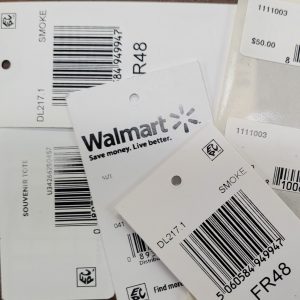
Suppliers selling certain product categories to Walmart must attach RFID tags to individual products before they reach the distribution network.
In many cases, RFID tags are placed on:
• Hangtags
• Packaging labels
• Adhesive stickers applied to product packaging
Each tag typically contains an EPC (Electronic Product Code) encoded using industry standards such as SGTIN serialization. This allows Walmart’s systems to uniquely identify each item moving through its supply chain.
Because encoding RFID tags requires specialized equipment and verification processes, many suppliers work with labeling providers that can produce RFID-ready tags and labels.
The Future of RFID in Retail
The Walmart RFID initiative represents a major shift toward smarter retail inventory systems. As more product categories adopt RFID technology, suppliers will increasingly rely on encoded labels and tags to meet retailer requirements.
Companies that prepare early for RFID compliance can benefit from faster supply chain operations, improved inventory visibility, and better overall retail performance.
Working With an Experienced RFID Label Supplier
Many retailers now require RFID compliance as part of their supplier programs. Rapidtags works with apparel brands to produce RFID labels and hangtags that meet the requirements of major retailers. Suppliers that understand the Walmart RFID mandate early can avoid costly delays when shipping products to Walmart distribution centers.
Our team has experience supporting suppliers working with retailers such as Walmart, Dillard’s, and other national chains, helping ensure that RFID tags are properly encoded and formatted for retail inventory systems.
If your brand needs RFID tags or encoded labels for retail compliance, our team can help guide you through the process.
Rapidtags works with apparel brands and suppliers to produce RFID hangtags and labels designed for retail compliance. Our team can help ensure that your tags meet encoding and labeling requirements so your products move smoothly through the supply chain.
If you have questions about RFID labeling, feel free to contact us at 877-438-8247 or email sales@rapidtags.com
- RFID Encoded/Decoder https://www.gs1.org/services/epc-encoderdecoder
- SGTIN-96 Serialization Management https://www.gs1us.org/content/dam/gs1us/documents/tools-resources/epc-adoption-roadmap/Guideline-EPC-enabled-RFID-Serialization-Management-for-SGTIN-96.pdf
How RFID Helps Reduce Retail Shrinkage and Prevent Inventory Loss