
No products in the cart.



Custom satin printed labels for clothing are a soft, durable, and cost-effective solution for branding garments. Our satin clothing labels are printed with sharp detail, available in multiple colors, and designed for comfort against the skin.
What Are Satin Printed Labels for Clothing?
Satin printed labels are clothing labels made from a smooth polyester-based material and printed with ink rather than woven with thread. This allows for sharp detail, small text, and multi-color designs that are not always possible with woven labels. They are especially useful for care labels and designs that require multiple colors or fine lines.
Satin clothing labels are typically printed rather than woven, allowing for sharp detail and small text. These clothing labels are commonly found in formal dresses, bedding, lingerie and infant clothing. Satin clothing labels are also excellent as care and content labels due to its slick background which allows a high level of detail and small print. We offer our printed satin clothing labels as either silk-screened or printed with thermal transfer ink.
When Should You Use Satin Labels Instead of Woven Labels?
Satin printed labels are often the better choice when your design includes fine details, small text, or multiple colors. Because satin labels are printed rather than woven, they can capture sharp lines and intricate artwork that may not translate well into a woven label.
Satin labels are also ideal for care and content labels, where readability is important. The smooth surface allows for clear printing of washing instructions, sizing, and other required information.
Woven labels, on the other hand, offer a textured, premium look and are often used for branding labels where durability and a high-end feel are the priority.
If your design is detailed or requires flexibility in color and size, satin printed labels are typically the best option. For a more structured and premium look, many brands choose woven labels for their primary branding.
Why Choose Satin Labels for Garments?
Satin is a type of particular textile weave that makes a glossy and sleek fabric. Satin fabric is weaved using four warp threads going over with one weft thread going under. This creates less interlacing between the threads. The result is a glossy surface and matte back. The weaving process that uses materials like silk, polyester or wool produces satin. Fabric made with a weave of cotton is usually called Sateen.
Satin is widely used in apparel because of its smooth texture and polished appearance. You’ll often find it in garments like lingerie, nightgowns, blouses, and athletic wear where a soft feel and subtle sheen are desirable. It’s also used in accessories and specialty items such as ties and ballet shoes.
For clothing labels, satin typically features either a glossy front with a matte back (single face) or a smooth, shiny finish on both sides (double face), depending on the application.

Are Satin Labels Comfortable to Wear?
Satin labels are known for their smooth, soft texture, making them comfortable to wear even when placed directly against the skin. Unlike some woven or stiff labels, satin does not feel scratchy, which is why it is commonly used for neck labels and care labels.
We can also print the clothing labels with an unlimited amount of colors. This is called digital full-color print. You would need to send us your artwork in order to get pricing. Because all the labels we make are custom, there is no limit to the colors and sizes that we offer. Please contact us for the details.
How Durable Are Satin Clothing Labels?
Satin clothing labels are a durable option for garments that require long-lasting care information and branding. Because satin clothing labels are made from a polyester based material and not a natural fiber, they can withstand many wash and dry cycles before any wear starts to show. Satin labels are best when applied to clothing after the garment has been dyed because the material can absorb the color if placed in dye directly. If you follow the proper care instructions for the garment then you should be able to extend the life and quality of your printed satin care labels. The most recommended care for polyester fabric is machine wash warm or cold, tumble dry on low and if needed, iron on a low temperature.
Types of Satin Labels (Single Face vs Double Face)
Satin labels are available in two primary types: single face satin, which has a glossy front and matte back, and double face satin, which is smooth and shiny on both sides. The choice between the two depends on how the label will be used and whether printing is needed on one or both sides.
In addition to face types, satin labels are also available in different edge finishes and constructions. The most common material used for printed clothing labels is polyester satin due to its durability and ability to hold fine detail.
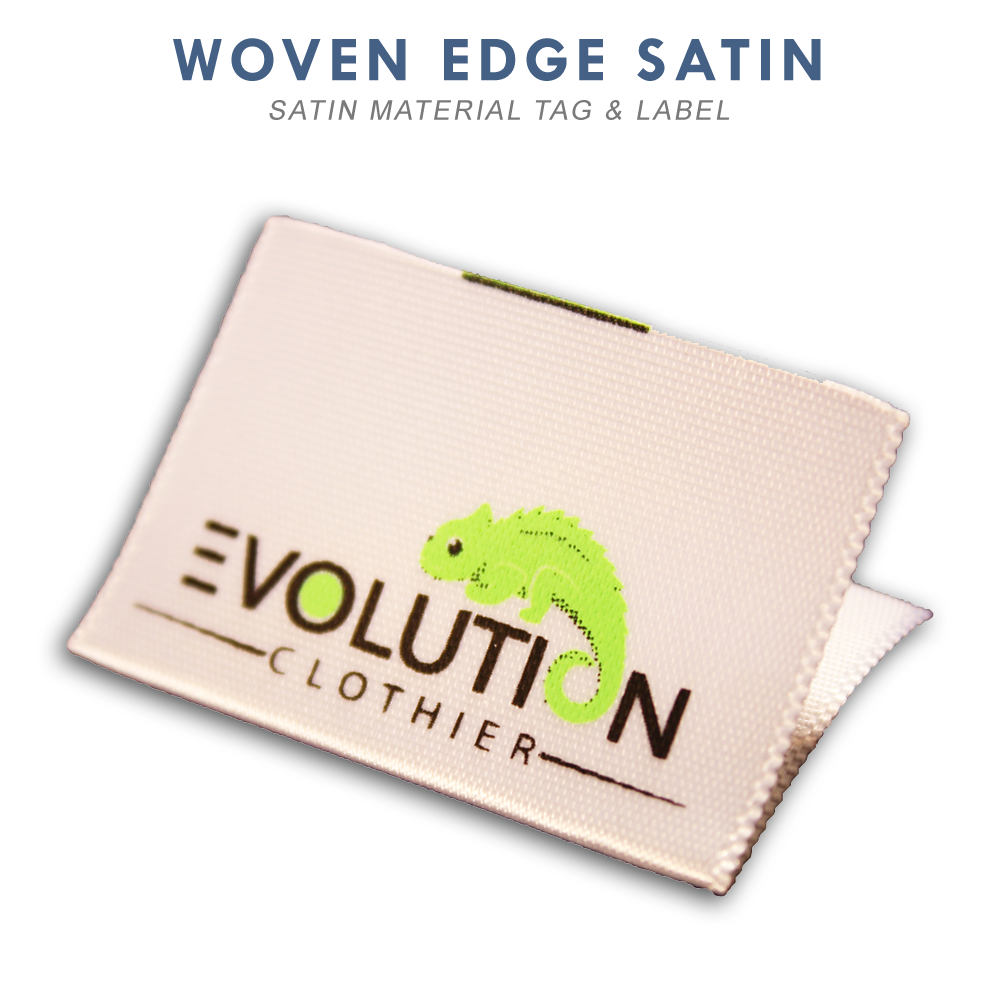
The first option is woven edge satin. This type has two finished edges and two cut edges, making it soft, durable, and the most commonly used material for printed satin labels. The back has a more matte appearance, and we can also print on the reverse side if needed.
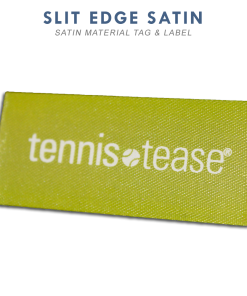
The second option is slit edge satin. This version is thinner, extremely soft, and has heat-sealed edges to prevent fraying. It offers a smooth, silky feel and is ideal when comfort is a priority.
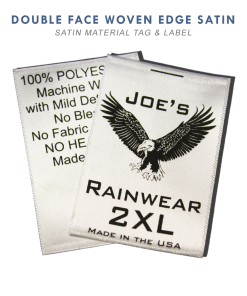
The third option is double face woven edge satin. This material is glossy on both sides and is commonly used when printing is required on both sides of the label. It is also the softest of the three options.
Satin Label Cuts and Folding Options

There are several cut and fold options to consider when designing a satin printed clothing label, depending on how the label will be applied to your garment.
If the label will be sewn into a seam, a centerfold (also called a loop fold) is the most common option. This method folds the label in half so the ends are secured within the seam, preventing fraying and creating a clean finish.
If you plan to sew the label on the left and right sides only, an end fold is a great choice. The edges are folded under, giving the label a polished and professional appearance.
For labels that will be sewn down on all four sides, a straight cut (flat label) is typically used. This allows the label to lay flat against the garment or accessory.
Additional options include die cutting for custom shapes, Manhattan fold (centerfold with folded ends), and mitre fold, which is sewn into a seam and hangs with angled edges.
Choosing the right cut and fold style depends on your garment type, application method, and desired finished look. See the images below for visual examples of each option.
Frequently Asked Questions About Satin Printed Labels
Are satin printed labels better than woven labels?
Satin printed labels are ideal for designs that require fine detail, small text, or multiple colors. Woven labels are better suited for simpler designs where a textured, premium look is preferred.
Do satin labels hold up after washing?
Yes, satin labels made from polyester are durable and can withstand repeated washing and drying when proper care instructions are followed.
Are satin labels comfortable to wear?
Satin labels are known for their smooth, soft texture, making them a comfortable choice for neck labels and garments worn directly against the skin.
Can satin labels be printed in full color?
Yes, satin printed labels can be produced in full color, allowing for detailed artwork, logos, and small text that may not be possible with woven labels.
Custom Satin Printed Labels for Clothing
-
Learn About The 3 Types of Satin Printed Labels
If you are not sure how or what to order, please call us! 877-438-8247
- Production time 7-10 business days
- Rush Service available – Please Call
- Digital proof will be sent within 48 hours
Related products


-
This product has multiple variants. The options may be chosen on the product page